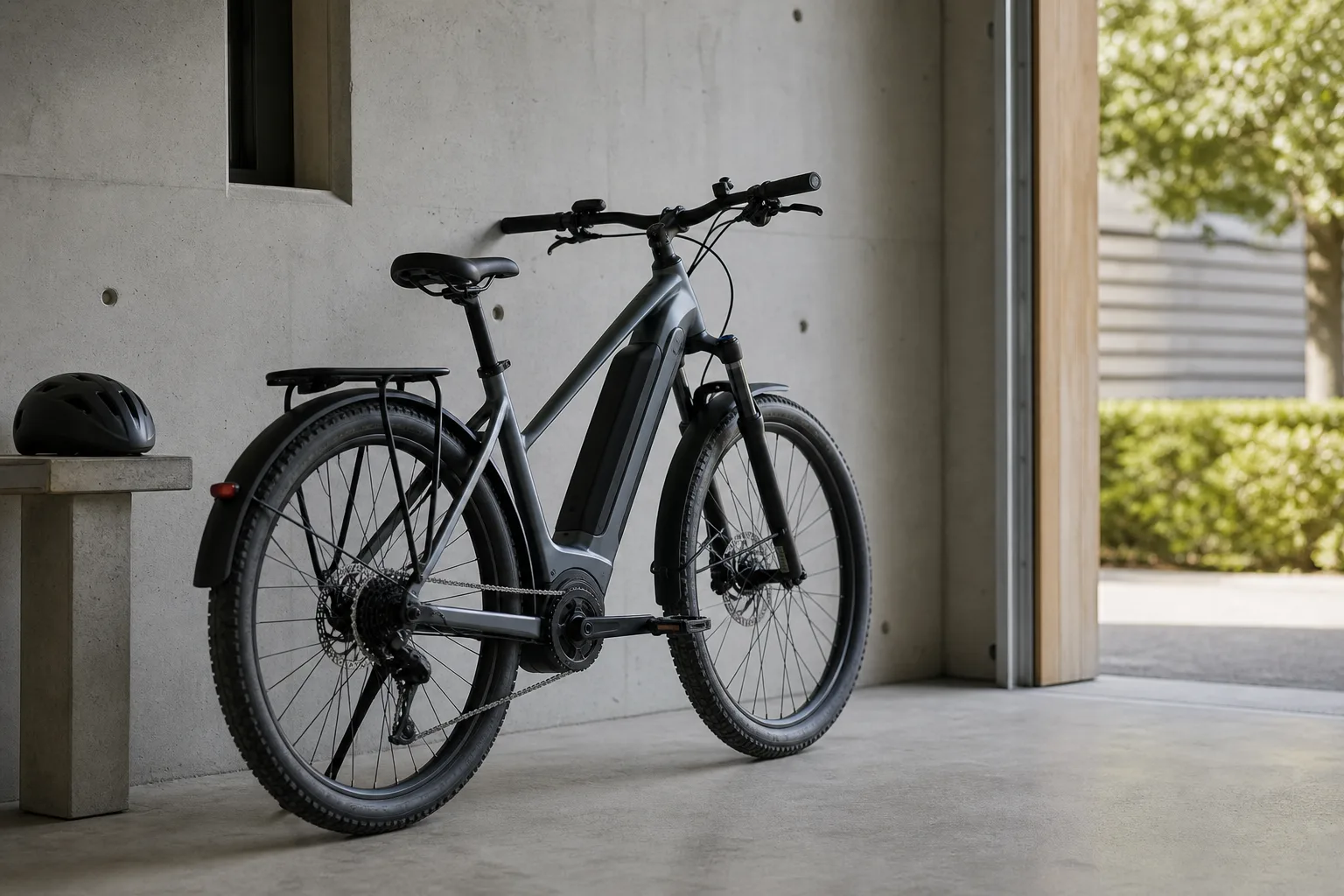
The first two years of electric bike ownership tell you almost nothing about the cost of the next five. Warranty coverage absorbs the failures that would otherwise be expensive, the battery still holds close to its rated capacity, and the shop that sold you the bike still stocks the parts. Year three is where the actual ownership math appears, and it appears in four places: capacity loss, parts availability, labor rates for motor work, and the number a buyer will hand you on the used market. Each of these can be checked before purchase, and each is routinely skipped.
1. Read the cycle rating as a floor, not a forecast
Manufacturers quote battery life as a cycle count paired with a remaining-capacity figure, and both halves matter. The count is measured under laboratory discharge conditions that have little to do with a commute in February, and the capacity figure describes the point at which the cell is considered degraded rather than the point at which the bike stops being useful. What owners report in year three is a gradual shortening of range that shows up first on the longest ride of the week. A careful reader checks whether the spec sheet names the cell manufacturer and the pack's amp-hour and watt-hour ratings, because a pack described only in vague terms is a pack whose replacement is hard to price.
2. Ask whether the replacement pack will exist
The single largest post-warranty expense on most electric bikes is a new battery, and the question is not only what it costs but whether it can still be bought. Packs are keyed to a specific frame and a specific electrical connector, and a brand that has revised its frame twice since your model shipped has little reason to keep tooling for the old case. Before buying, check the manufacturer's parts page for replacement packs covering models three and four years old. If those listings exist, are priced, and are in stock, that is meaningful evidence about how the company treats owners after the sale.
3. Find out what is proprietary and what is standard
Brakes, chains, cassettes, tires, and bearings are usually standard bicycle parts that any shop can source next day. Displays, wiring harnesses, controllers, torque sensors, and the motor itself are usually not. The practical test is to open a large online bicycle parts retailer and search for the model's display and controller by part number. Parts that appear in the general aftermarket will be available in a decade; parts that appear only on the brand's own site will be available for as long as the brand chooses. Bikes built around widely used motor systems tend to sit on the good side of this line, and that advantage compounds every year.
4. Price motor service before you need it
Shops bill motor work as labor plus parts, and the labor figure depends on whether the technician has been trained on the system and has the diagnostic software to read fault codes. Call two shops within a reasonable ride of your home, name the motor system you are considering, and ask whether they service it and what their hourly rate is. A shop that says yes without hesitation is worth more than a modest discount on the purchase price. Owners who bought a system their local shops support describe routine work, bearing replacement, sensor swaps, firmware updates, as an appointment rather than a shipping ordeal.
5. Watch the resale market for the model you want
Used electric bikes are priced by buyers who are asking exactly the questions above, which is why resale value tracks parts availability more closely than it tracks original price. Search completed listings for three-year-old examples of the model on your shortlist and note both the asking prices and how quickly they sold. Bikes on well-supported motor systems, with batteries that can still be bought new, hold a visibly larger share of their purchase price, and they hold it because the next owner can see a path forward. A service record and the original charger both help.
The Federal Trade Commission oversees how warranties are written and disclosed, and reading the warranty document before purchase is the cheapest research available: it names the covered components, the capacity threshold at which a battery qualifies as failed, and who pays freight. Ten minutes with that document, plus two phone calls, tells you most of what year three will cost.