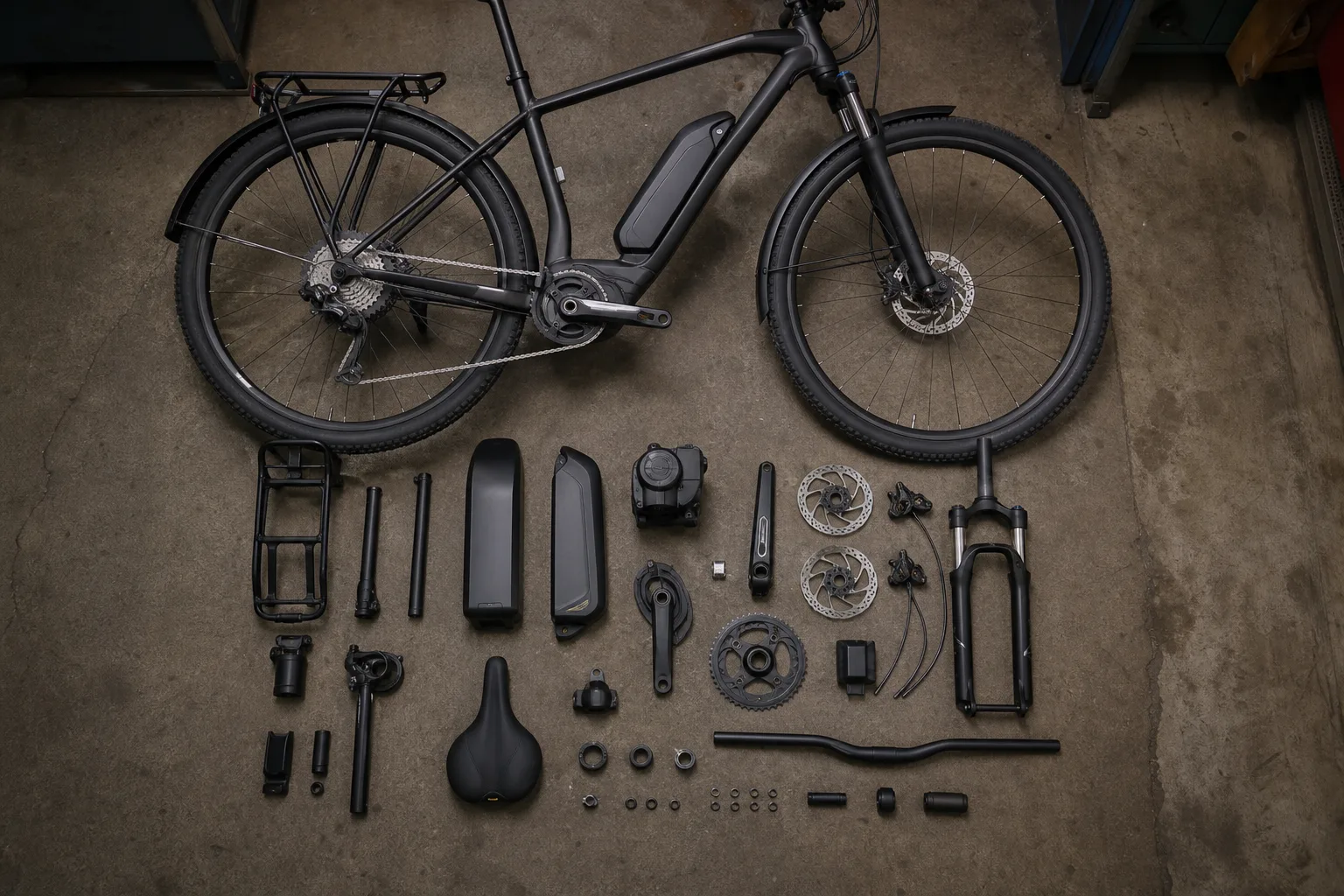
Two electric bikes can share a spec sheet and differ by nearly three thousand dollars, which suggests either that one is badly overpriced or that the sheet is leaving something out. Usually it is the sheet. A motor rated at 250 watts nominal tells you almost nothing about how the bike climbs, a 500 watt-hour battery tells you almost nothing about range, and neither number touches the parts that decide whether the bike is still pleasant in its third winter. The money is real, but it is distributed in places that are hard to photograph.
The parts of the price that have nothing to do with the motor
Strip the electronics out and a $1,200 electric bike is a $400 bicycle, while a $4,000 one is often a $1,300 bicycle. That gap shows up in the fork, the wheels, the brakes and the drivetrain, and it shows up under load, because an electric bike is heavier and faster than the bicycle it resembles. Hydraulic disc brakes with four-piston calipers and larger rotors cost more than cable-actuated discs and stop a sixty-pound machine differently. Double-wall rims with thicker spokes survive potholes that taco a budget wheel. Sealed bearings in the headset and bottom bracket outlast unsealed ones by years in salted road spray.
Hub motors, mid-drives, and where the extra money is doing work
A rear hub motor drives the wheel directly, ignores the gears, and is simple, quiet and cheap to build. On flat and rolling terrain, with a rider who is not carrying much, it does the job well, and the money saved buys better brakes and a better battery. A mid-drive puts the motor at the cranks so its output passes through the cassette, which means the motor can spin in its efficient range while the wheel turns slowly, which is exactly what a steep hill with cargo demands. It also centers the weight low and makes rear wheel repairs ordinary rather than an event. Torque sensing, usually paired with mid-drives, reads how hard you press rather than whether you are pedaling at all.
The premium is worth paying when the terrain is genuinely steep, when the load is a child seat or forty pounds of groceries, or when the ride is long enough that motor efficiency shows up as remaining battery at the end. It is worth less on a flat commute of four miles. Mid-drives also transfer their torque to the chain and cassette, so those wear faster, and the maintenance line in year two is higher.
Turning watt-hours into hills and miles
Multiply nominal voltage by amp-hours and you get watt-hours, the only battery figure worth comparing across brands. A 36-volt, 14-amp-hour pack is 504 watt-hours. What that carries you depends on how many watt-hours per mile the system draws, and that number moves with rider weight, cargo, tire pressure, headwind, assist level and above all elevation. A light rider on flat pavement in a low assist mode might see figures at the efficient end of the range; the same bike loaded, climbing, in maximum assist, can consume several times as much per mile. Range claims are typically produced at the flattering end of that spread. The honest way to read a battery is as a reservoir with a wide variance, and the honest way to size it is against your worst regular ride, not your average one.
Larger packs cost money and add weight, and weight matters most on the days the battery is empty. A second battery, if the frame supports one, is often cheaper than the next model up.
What a careful reader checks before paying
Look for the cell manufacturer and the certification mark on the pack, since battery safety is the part of an electric bicycle overseen by the Consumer Product Safety Commission and the part where anonymity is a warning. Ask what the replacement pack costs today and whether it will still be sold in five years, because a discontinued proprietary battery ends a bike. Check whether the motor and controller come from a firm with a US service network, or whether the shop can even get parts. Read the torque figure in newton-meters rather than the wattage. Confirm the brake rotors, the spoke gauge, the tire width and whether the rack is rated for what you intend to carry.
Two bikes, one at each end of that price range, can both be the right purchase. The question is whether the extra is buying hardware you will use on the route you actually ride, or a specification you will admire and never load.